

What defines value in art? Is it the materials, the vision, or the story it tells? In the elite world of contemporary art, price tags often defy logic, with seemingly simple or even intangible pieces selling for millions. From a banana duct-taped to a wall to an “invisible sculpture” that exists only in the mind of the artist, these works challenge our understanding of luxury, creativity, and excess.
Join Glam/Amour as we step into the surreal realm of unbelievably extravagant artwork—where concepts reign supreme, perception is everything, and the line between genius and absurdity is as fine as a brushstroke on a multi-million-dollar canvas.
The $6.2 Million Banana: Maurizio Cattelan’s “Comedian”
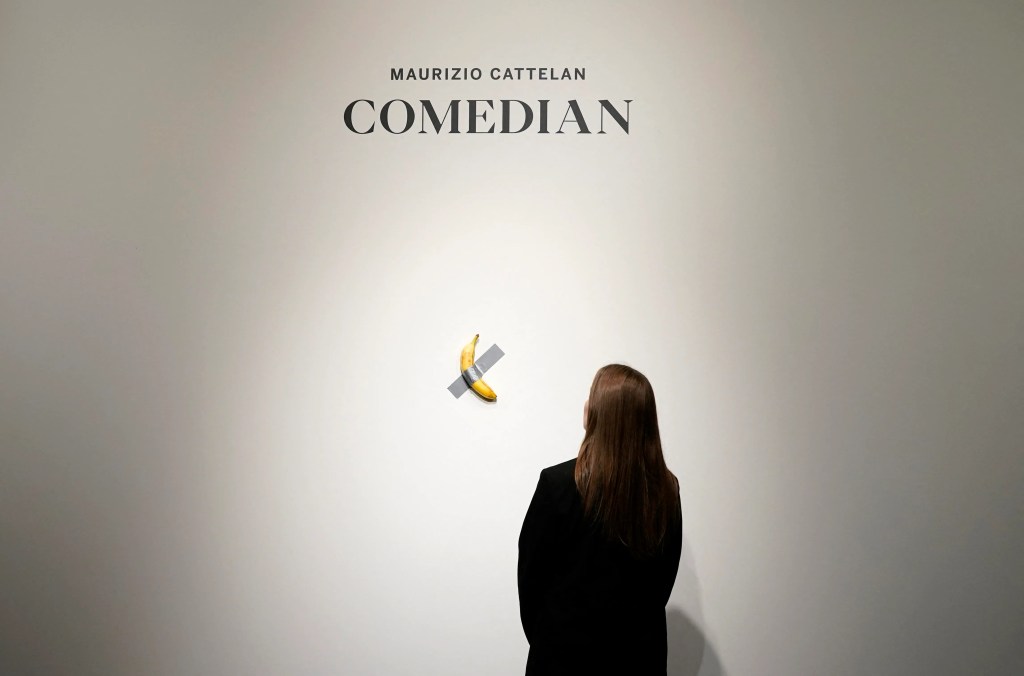
In 2019, Italian artist Maurizio Cattelan unveiled “Comedian,” a simple yet provocative piece featuring a banana duct-taped to a wall.
Initially displayed at Art Basel Miami Beach, the artwork was priced at $120,000, sparking widespread media attention and public discourse. Fast forward to November 2024, and “Comedian” made headlines again when it sold for a staggering $6.2 million at a Sotheby’s auction in New York.
The buyer, cryptocurrency entrepreneur Justin Sun, emphasized the work’s cultural significance, stating, “It represents a cultural phenomenon that bridges the worlds of art, memes, and the cryptocurrency community.”
Interestingly, the banana itself, a perishable item, is not the core of the artwork; instead, purchasers receive a certificate of authenticity and instructions for its display, highlighting the conceptual nature of the piece.
The Invisible Sculpture: Salvatore Garau’s “Io Sono”

Pushing the boundaries of conceptual art even further, Italian artist Salvatore Garau presented “Io Sono” (“I Am“) in 2021, an “immaterial sculpture” that exists solely in the imagination.
This artwork, devoid of physical form, was auctioned for €15,000 ($18,300). The buyer received a certificate of authenticity and instructions specifying that the piece should be displayed in a space free from obstructions, measuring approximately five by five feet.
Garau defended his creation by stating, “The vacuum is nothing more than a space full of energy… even if we empty it and there is nothing left, that nothing has a weight.“
Scribbles Worth Millions: Cy Twombly’s “Untitled (New York City)”

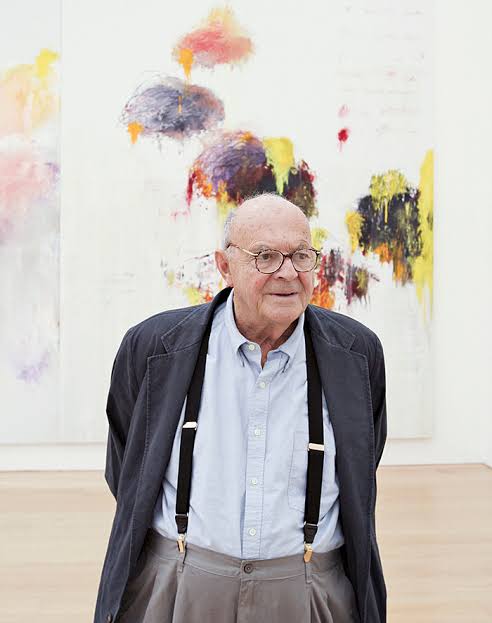
In a testament to the abstract, American artist Cy Twombly’s 1968 painting “Untitled (New York City)” features white chalk-like scribbles on a gray background, reminiscent of a school blackboard.
Despite its seemingly simplistic appearance, the piece fetched a record $70.5 million at a Sotheby’s auction in 2015. This sale not only set a new benchmark for Twombly’s work but also highlighted the art market’s appreciation for pieces that challenge traditional aesthetics and provoke contemplation.
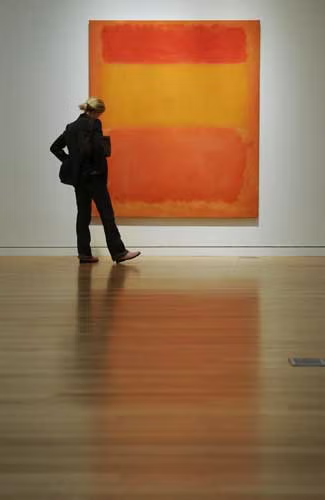
Forty-two years after his death, Mark Rothko sets records at a Christie’s auction, which, again, has its own reasons to walk down the pages of history. A brilliant camaraderie of three colors, Orange, Red, Yellow – Rothko’s timeless creation from 1961, shattered all records for post-war and contemporary art by fetching $87 million.
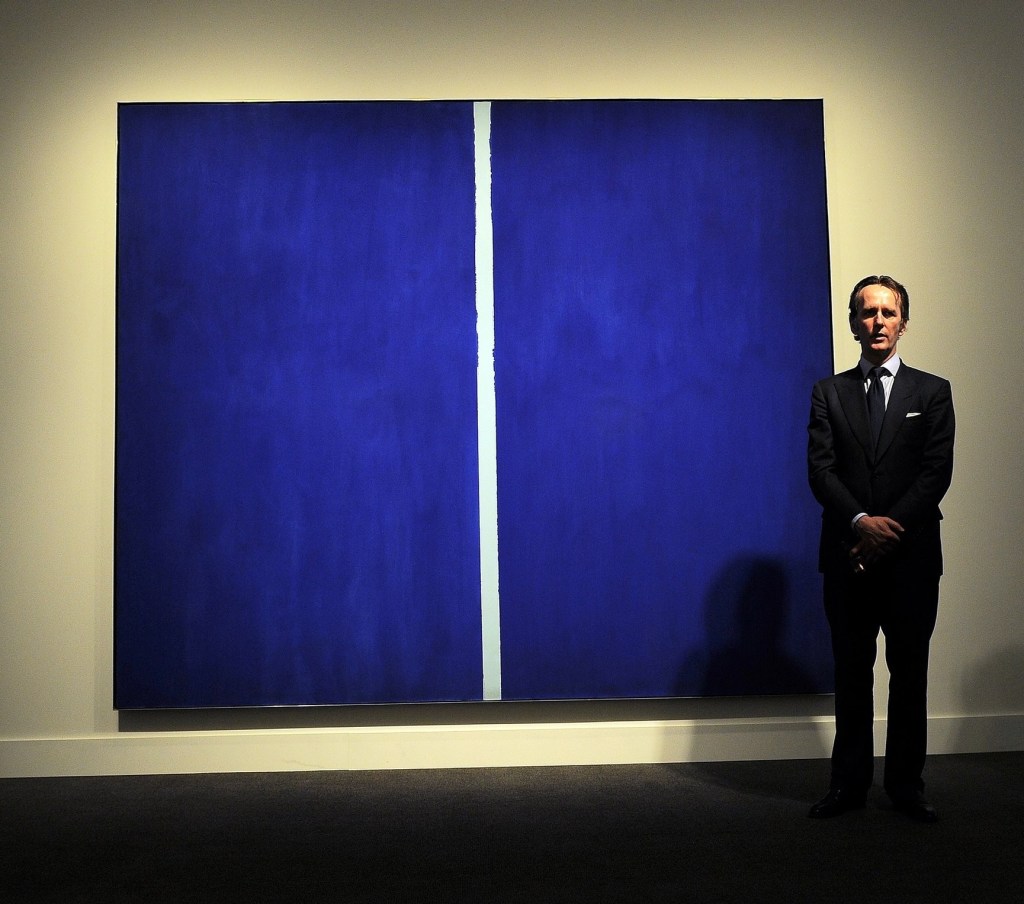
Artist Barnett Newman’s 1953 painting “Onement VI” sold at a Sotheby’s auction in New York City for more than $43 million.
The Battle Between Perception and Price
For the everyday observer, the idea of paying millions for a banana that will rot, a canvas of scribbles, or an artwork that doesn’t physically exist feels almost absurd. These extravagant sales blur the line between Artistic Genius and Audacious Spectacle, raising questions about what truly defines value in the art world. Are these pieces symbols of artistic revolution, or are they simply a reflection of an elite market detached from reality?
Yet, despite the skepticism, these works command attention, forcing audiences to rethink the very nature of art and its worth. Perhaps that is their true power—not in their physical form, but in their ability to challenge, provoke, and redefine the meaning of luxury.
In the end, while the everyday man may battle with the bizarre, the art world thrives on it. And as long as collectors continue to place value on the intangible, the most extravagant artworks will always find a buyer.






 GLAM / AMOUR
Hope you liked the article! Let us know what you think!